-
Core approaches to teaching EAL/ESL literacy include:
- Teach oral language first
- Explicitly teach literacy skills
- Use learning materials that are appropriate for literacy learners
- Consider brain space/cognitive load
- Create routines
- Use hands-on learning
- Use LEA (Language Experience Approach)
- Use whole-part-whole
- Scaffold learning
- Recycle and spiral learning
3.1 Teach oral language first
The first core approach to teaching EAL/ESL literacy is to first focus on the development of oral language. Learners must work with familiar oral language to support their development of reading and writing. For a complete discussion of teaching oral language to literacy learners, see section 5.
3.2 Explicitly teach literacy skills
One of the primary approaches to teaching EAL/ESL literacy is to explicitly teach literacy skills. Literacy skills include:
- Learning about texts and meaning
- The sounds of English
- Phonics, letter formation, and spelling patterns
- Reading comprehension
- Writing sentences and short paragraphs
- Fluency
These skills are not all taught at once. They are introduced gradually over time. For a complete discussion of teaching literacy skills to EAL/ESL literacy learners, see section 6.
| The Development of Literacy Skills in the CLB | ||||
| Foundation L | CLB 1L | CLB 2L | CLB 3L | CLB 4L |
| Letters | Words | Sentence Frames | Sentences | Paragraphs |
| Texts and meaning (Intensive) | Texts and meaning (Ongoing) | |||
| The sounds of English (Intensive) | The sounds of English (Ongoing) | |||
| Letter formation (Intensive) | Phonics, sight words, and spelling patterns (Intensive) | Phonics, sight words, and spelling patterns (Ongoing) | ||
| Reading comprehension (Intensive) | ||||
| Writing sentences (Intensive) | Writing short paragraphs (Intensive) | |||
| Fluency (Intensive) | ||||
3.3 Use learning materials that are appropriate for literacy learners
- contains only familiar language
- is on a personally relevant topic
- Century Gothic
- Comic Sans
- Mangal Pro
- Tenorite
| Level | Font | Font size | Wrap-around text | Sentence type | Pictures |
| Foundation L | literacy-friendly | Very large 18+ pt | No | Words | Clear photographs on a white background and a few very familiar symbols |
| CLB 1L | literacy-friendly | Very large 18+ pt | No | Repeated sentence stems and very simple sentences | Clear photographs on a white background and a few very familiar symbols |
| CLB 2L | literacy-friendly | Large 16-18 pt | Some | Simple sentences | Clear photographs and very familiar symbols |
| CLB 3L | any clear, standard font | Medium 14-16 pt | Yes | Simple sentences and some basic compound sentences | Clear photographs, some clear drawings, and familiar symbols |
| CLB 4L | any clear, standard font | Regular to medium 12-14 pt | Yes | Simple sentences and compound sentences | Photographs, drawings, and a wider range of symbols |
3.4 Consider brain space/cognitive load
Cognitive load is the amount of information a brain can handle at any one point. Think of it as the desk space of your brain, with each element of a task taking up some of the space. One of the key approaches to teaching EAL/ESL literacy is to monitor cognitive load so that learners have capacity to focus on what they are learning.
Each element of a task adds to the cognitive load. In order to complete reading tasks, literacy learners must attend to the work of reading. Proficient readers complete this work with automaticity, while literacy learners must concentrate and think about each part.
Depending on level, the work of reading includes:
- Understanding the instructions of the task
- Understanding the purpose of the task
- Using pre-reading strategies such as scanning and making predictions
- Decoding words (using phonics and spelling patterns)
- Holding what they are decoding in working memory until they understand the sentence
- Recalling vocabulary and structures
- Making meaning out of what they have read
- Demonstrating comprehension, often through matching, indicating photographs, or answering comprehension questions
Tasks often include other layers that also require attention:
- New vocabulary
- New grammar or structures
- New context
- New topic
- Familiar skills at a higher level
- Longer text
- New formatting
- Numeracy
- Digital literacy
- Increased visual literacy
A proficient reader performs all of this with automaticity and has lots of brain space leftover for comprehension, thinking about what the text means, considering the perspective, comparing it to what they already know, learning from the text, and so on. A literacy learner must attend to every aspect of the text with focus and concentration, and often the process of decoding is so arduous that there is not a lot of brain space left over for comprehension.
Watch for signs that learners are overwhelmed. These include signs of fatigue, zoning out, or finding familiar tasks difficult. When learners are overwhelmed, switch activities. Move to something that is active or hands-on, such as a game or stations activity, or read aloud to them from familiar books. When learners are rested again, return to the activity with an increased level of support, modify the activity to better meet their level, or choose a different activity to tackle the same skills.
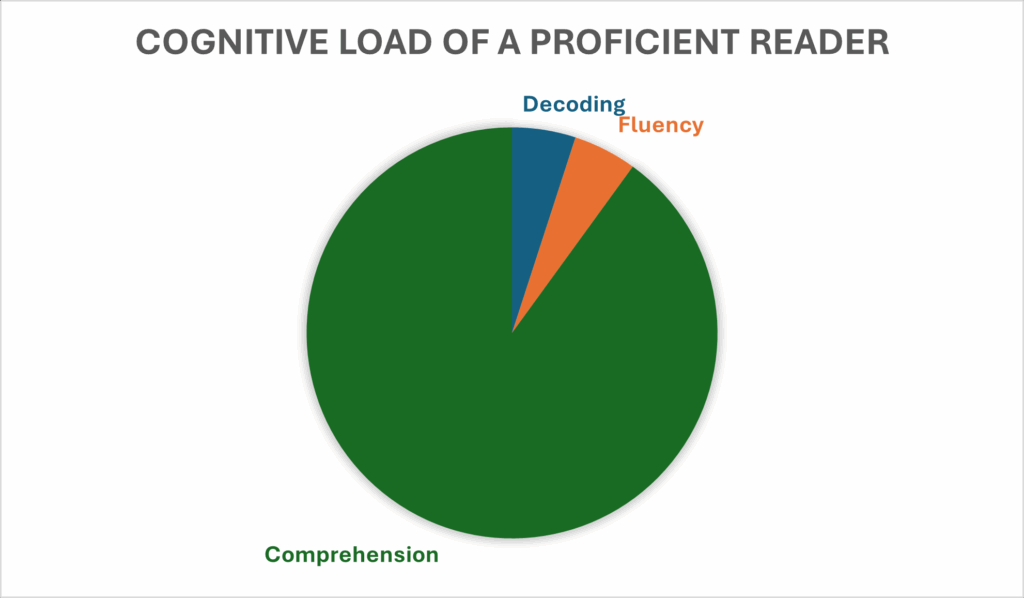
Cognitive Load of a Proficient Reader
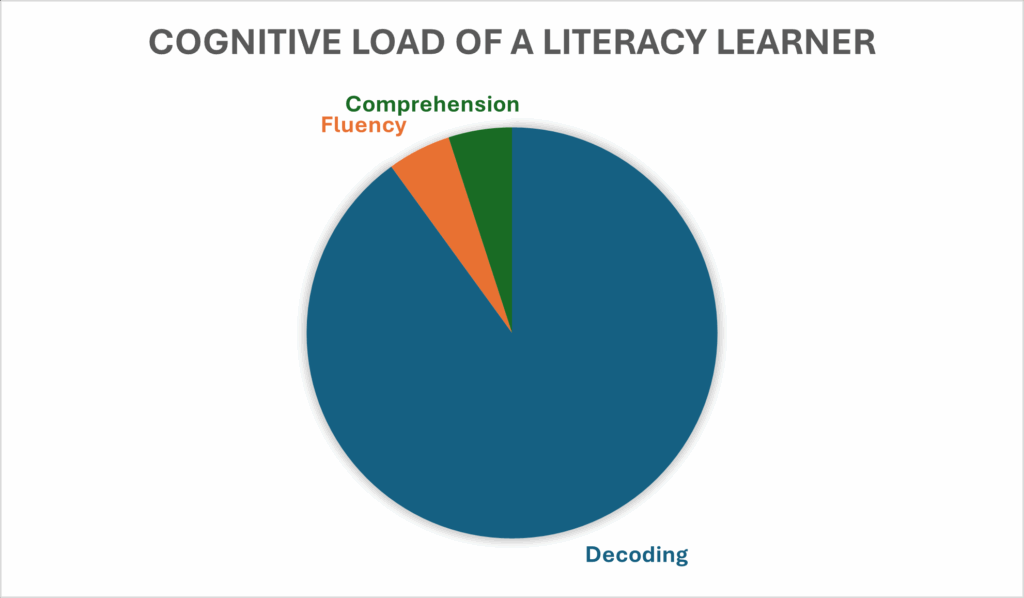
Cognitive Load of a Literacy Learner
Instructors should be aware of cognitive load and lower the cognitive load required for a task whenever possible. Strategies for reducing cognitive load include:
- Lots of repetition
- Familiar language
- Familiar topic
- Familiar format
- Familiar kind of task
- Sight words: words the reader can decode easily
- Clear photographs
- Shorter tasks
- Tasks broken down into steps
- Working together with a partner
- Clear, simple instructions given orally
- Scaffolding: sentence stems, word banks, tracing or copying, circling instead of writing, and so on
- Carefully considered aspects of numeracy
- Carefully considered aspects of digital literacy
3.5 Create routines
- Routine is an effective part of trauma-informed strategies because it gives learners a sense of predictability and control over what is going to happen.
- Routine lowers cognitive load because more aspects of the day are familiar and known, allowing learners to focus on what’s new.
- Routine allows learners to develop formal learning strategies such as scheduling and reading an agenda.
- Routine allows for repeated language, giving learners lots of opportunity to learn basic classroom language.
- Begin the class in the same way each time. Consider including:
- Personal greetings to each learner
- Check-ins on how each learner is doing
- Writing the day and date on the board
- Writing the weather on the board
- Creating a calendar of rotating class chores, such as watering plants, setting up stations, or greeting others
- Making announcements
- Giving learners a word, words, or short sentence to copy
- Singing a song
- Writing the class agenda on the board
- Setting a class goal or goals for the day
- End the class in the same way each time. Consider including:
- Singing a song
- Reviewing words learned during the class
- Reviewing goals for the day
- Asking each learner a question based on what they learned that day
- Reminding learners of upcoming events
- Letting learners know when the next class is (See you tomorrow! See you on Monday!)
- Saying goodbye to each learner
- Post the agenda in every class, either with cards with pictures that can be reused or by writing words on the board, depending on the level
- As activities are finished, put a check mark by the item on the agenda or have a learner put a check mark
- Approach activities in the same or similar way
- Give the same or similar instructions for activities
- Repeat the same process for activities so that learners know what to expect
- Use the same format as much as possible for activities
- Help learners to organize their learning
- Use repeated symbols for activities, such as a symbol for reading, writing, listening, and speaking, so learners understand how to organize their papers
- Take time after every activity to look at the symbol and find the right place in the binder
- File tasks in the portfolio
3.6 Use hands-on learning
EAL/ESL literacy learners typically do not have many formal learning strategies and are not used to sitting for long periods of time. The learning they have done in their lives has often been done by watching and doing rather than formally studying. The act of reading and writing is also very labour-intensive for literacy learners, and they won’t be able to sustain that level of concentration for very long.
Additionally, literacy learners need to build foundational skills such as hand-eye coordination, hand strength, and tracking. These are necessary to be able to follow print and form letters. Once learners can form letters, they will need to practice their printing until it is quick, neat, legible, and can fit the size given.
| Activities to Build Foundational Literacy Skills | ||
| Tracking | Hand strength | Hand-eye coordination |
| The ability to follow a line of text with your eyes or to be able to flick your eyes between two sources; necessary for reading and copying | The strength and flexibility in your hands and fingers; necessary for holding a pen or pencil and forming letters | The ability to coordinate the movement of your hands; necessary for printing |
|
|
|
| Hands-On Activities | |||
| Hands-On Materials | Movement | Listening and Speaking | Music |
|
|
|
|
3.7 Use LEA (Language Experience Approach)
LEA, or Language Experience Approach, is an approach to teaching literacy that was first developed for Maori children in New Zealand in the 1960s and has been used with literacy learners of all ages around the world.
How to use LEA:
- Have an experience as a class such as a game, activity, field trip, or community walk.
- If possible, take photographs of the experience to help with recall and to illustrate the story.
- Have learners tell the story of what happened.
- Record what learners say.
- Use this story as the basis for further reading and writing activities.
LEA is a very effective activity and a core approach for teaching EAL/ESL literacy because:
- It uses language that comes from the learners, creating a text entirely made up of familiar words and structures.
- It is based on a shared, familiar experience.
- It shows learners the connection between written language and spoken language.
- It doesn’t require any special preparation.
- It values the voice of the learners as writers and storytellers.
- It helps with engagement because learners see themselves in the stories.
3.8 Use whole-part-whole
- First Whole:
- Scan the title and pictures
- Make predictions
- Activate what you already know about the topic
- Reading the text for general understanding
- Part:
- Re-read the story with a focus on decoding (using sight words, phonics, and spelling patterns)
- Look at target letters, sounds, word parts, words, or sentences
- Match vocabulary cards to vocabulary in the story
- Look at specific events in the story
- Complete writing activities based on the story, such as writing words, completing sentences, or forming sentences
- Final Whole:
- Re-read the story for a deeper understanding
- Sequence the events in the story
- Talk about the characters
- Answer comprehension questions
- Read the story many times for fluency
- Share the story with someone else
- Complete writing activities based on the story
3.9 Scaffold learning
| Modifications to the task | Supports for the task |
|
|
3.10 Recycle and spiral learning
Like all language learners, EAL/ESL literacy learners need multiple meaningful encounters with a word to integrate it into their vocabulary, and they also need to practice literacy skills many times before they can use them independently. Recycling is essential for teaching EAL/ESL literacy learners. This process of setting up multiple opportunities to use the same language and literacy skills is called recycling.
Strategies for recycling include:
- Teach thematically: organize teaching into theme modules so that the same words and skills can be used many times.
- Put target vocabulary in visible places: Give learners a personal set of vocabulary cards for the module (with words and clear pictures) to use in many different activities. Post the vocabulary on the wall as well so that it can be referred to frequently.
- Intentionally build activities and tasks that use the same vocabulary: Create or modify tasks and activities to ensure the same words are encountered again and again.
- Do variations of the same activities: Find multiple ways to practice the same skill, such as filling in your name and personal information on a form and repeat in slightly different formats and contexts over time.
- Use singing and chanting: Singing and chanting are naturally repetitive and use rhythm and rhyme to help with memory. Songs and chants are also meant to be sung multiple times.
Spiralling is related to recycling and is the process of returning to the same material or skills over a longer period of time at a higher level, for example returning to a now-familiar skill or familiar language and using it with a longer or slightly more difficult text.