- Learners who are exhausted, hungry, feel unsafe, or feel that their loved ones or community members are unsafe will struggle to focus on learning.
- The state of having your basic needs met and being ready to learn is called availability for learning.
- Instructors cannot guarantee that learners have their needs met, but there are some strategies instructors can use for availability for learning.
- Oral language is the foundation for literacy skills.
- To learn to read and write, learners must work with words they already know orally.
- Learners must know the relationship between sounds and letters so they can read letters to blend sounds into words or break words into sounds and represent them with letters.
- “General knowledge” is culturally informed. Literacy learners may have a very different set of common knowledge than non-literacy learners and may have many gaps in formal education.
- Learners bring considerable knowledge and experience to their learning.
4.1 Availability for learning
Availability for learning includes:
- Having enough food and water
- Having enough sleep
- Feeling secure about your housing
- Feeling secure that you will continue to have enough food, water, and sleep
- Feeling physically safe
- Having access to adequate medical care
- Feeling that your children are physically safe
- Feeling that your family, friends, neighbours, and community members are safe
- Feeling financially secure
- Having the resources to see and hear the instruction, such as glasses or hearing aids, and in the case of people who are blind or deaf, other appropriate supports as needed
- Recognize the importance of availability for learning and be aware of the many possible barriers for learning.
- Make learners aware of supports and resources available to them, such as second-hand stores, food banks, counselling through the school or community, and subsidized housing.
- Refer learners to resources when possible or appropriate.
- Treat learners with respect and compassion.
- Set expectations for attendance and punctuality but recognize there are many barriers to both for most learners, and most learners are doing their best.
- Never call out or embarrass a learner for their behaviour in front of other learners. If you need to address behaviour, do it privately.
- Never embarrass sleeping learners. They probably need the sleep. If they are disturbing others by sleeping, gently wake them.
- Be sensitive to the economic realities most EAL/ESL literacy learners face when you choose learning materials.
- Choose images of housing that look like the housing in your community and choose mostly images of lower-income housing.
- Always treat food with respect and recognize that choices around health and sustainability usually come second to affordability.
- Consider carefully whether common classroom events such as potlucks are a hardship for learners.
4.2 Oral language
Oral language, the skills of speaking and listening, are critically important to the development of literacy and must come first. When teaching EAL/ESL literacy, it is essential to first teach some oral language before teaching any reading and writing. All reading and writing must be based on words that are orally familiar, common, relevant, and known.
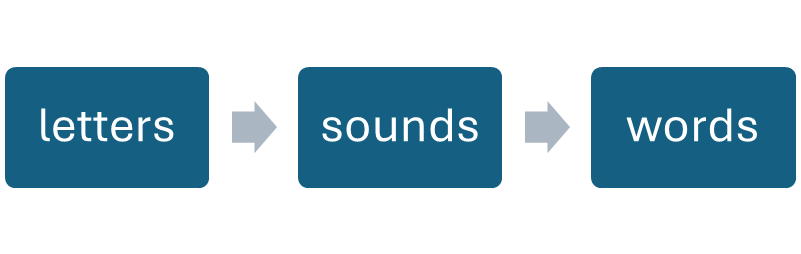
Learning to read and write for the first time relies on connecting the symbols on the page with a spoken word. In a language like English, which (mostly) has a phonetic relationship between letters and sounds, it is also a process of associating letters with sounds and blending them into a word or breaking a word into sounds and associating them with letters.
Reading:
Writing:

- Knowing the sounds: the ability to distinguish, identify, and produce the sounds is essential to connecting letters with sounds and either breaking words into sounds or blending sounds into words.
- Knowing the words: having some knowledge of vocabulary is essential to recognizing the words you are reading.
- Knowing the structure: having some knowledge of the structure of English, such as basic subject-verb-object word order, helps learners predict what should come next when they are reading and will help them make sense when they are writing. Note this grammatic knowledge does not need to be taught with grammatical terms and can be taught through rhythm, chants, songs, and dialogues.
- comparing unknown words to known words (e.g. comparing friendship to friend)
- breaking them into parts (e.g. recognizing that fishing must be an action because of the -ing ending)
- using resources such as word cards or picture dictionaries
| Foundation L CLB 1L CLB 2L |
100% of the words they read should be in their oral vocabulary. |
| CLB 3L CLB 4L |
95-99% of the words they read should be in their oral vocabulary. |
4.3 Knowledge and experience
EAL/ESL literacy learners typically have 0-9 years of previous formal education before coming to Canada. They have also often led very different lives than the average Canadian. This can lead to:
- Gaps in their formal knowledge and understanding about the world.
- Knowledge and experience in areas that are less familiar to most people in Canada.
For example, learners may not know many of the things that are considered “general knowledge” for educated adults in Canada, such as the geography of the Earth or the placement of the sun at the centre of a solar system with planets in orbit around it. Gaps in knowledge can impact reading comprehension; if learners are unfamiliar with a concept, then the text they are reading may not make sense. This kind of struggle with reading comprehension can occur at any level, but is most common at CLB 3L-4L, when learners are starting to read short paragraphs or longer texts.
Strategies for working with gaps in knowledge or experience include:
- Activate background knowledge before reading a text. Elicit from learners what they already know about the topic.
- Identify key concepts in the text and explicitly teach these concepts before reading, just as you would pre-teach vocabulary.
- Encourage questions.
- Use clear photographs and/or videos to help teach concepts. Choose images that are clear, such as a photograph on a white background.
- Avoid assumptions about “general knowledge.” General knowledge is culturally informed, and the general knowledge in Canada is very different from the general knowledge in a village in South Sudan or Syria.
On the other hand, EAL/ESL literacy leaners often bring a lot of knowledge and experience from their lives that can be considerable. Learners typically have the cultural knowledge of their cultures, such as their religion, food, clothing, traditions, and stories. They also often have practical knowledge. This knowledge can be literally about anything but often includes things such as:
- Hands-on skills such as building or working with wood or other materials
- Mechanical skills such as repairing cars or small engines
- Crafting skills such as sewing, knitting, quilting, beading, or embroidery
- Cooking, cleaning, and raising children
- Gardening or farming
- Raising animals for milk, eggs, or meat
- Speaking multiple languages
- Trading, bartering, and sales
- Survival skills in their area of the natural world
- Survival skills when dealing with war, conflict, or fleeing unsafe situations
Strategies for working with learners’ knowledge and experience include:
- Choose topics that are relevant and familiar to learners.
- Activate what learners already know about the topic.
- Allow learners the opportunity to be experts. Ask them to explain things to you.
- Recognize and celebrate all knowledge.
- Recognize that learners often speak multiple languages. When learning a new word, occasionally have them teach you the word in their language(s).
- When teaching employment, identify skills they have from their lives and include these in examples of skills. Include traditionally unpaid work such as cooking, cleaning, raising children, and often gardening and crafting.